Our co-production
Our co-production model
Following a review of co-production in Hertfordshire Adult Care Services, we have introduced a new co-production model. It gives people with lived experience a stronger voice and keeps co-production at the heart of how services are planned, delivered and improved. The model builds on the success of our previous co-production boards and creates stronger links between communities, services and decision-making.
Why have we changed the model?
Co-production has helped shape Adult Care Services for many years. People who use services, carers, families, partner organisations and voluntary groups have all helped influence strategies, service development and action plans.
The review highlighted ways to make co-production even stronger. These included creating clearer ways for people to share feedback, improving links between groups and making sure lived experience helps shape both services and strategic decisions. In response, we have brought strategy groups and User Voice services together in a more joined-up model. This improves communication, reduces duplication and increases the impact of co-production across Adult Care Services.
How the model works
At the centre of the model is the Strategic Co-production Board. It provides oversight and helps make sure the views of people with lived experience influence priorities and long-term planning.
The board is supported by Strategy Steering and Delivery Groups for:
- All Age Autism
- Carers
- Dementia
- Learning Disability
- Physical Disability
- Mental Health
These groups focus on specific areas of Adult Care Services and help develop, deliver and monitor strategies.
The model also includes commissioned User Voice services and community forums. These give people with lived experience, carers and families opportunities to share their views, experiences and ideas. Feedback from these groups is shared with the relevant strategy groups and the Strategic Co-production Board, helping ensure decisions are informed by the people most affected by them.
See a bigger version of this image (PDF 37KB)
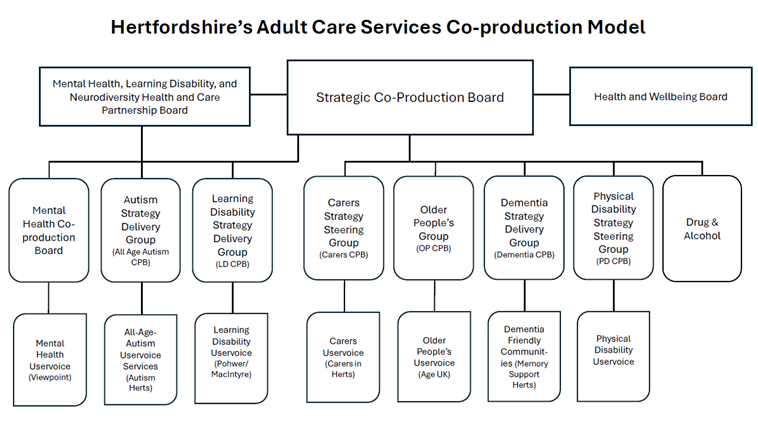
The diagram shows Hertfordshire's Adult Care Services Co-production Model as a three-level structure.
The Strategic Co-Production Board provides leadership for the model, and works alongside the:
- Health and Wellbeing Board
- Mental Health, Learning Disability and Neurodiversity Health and Care Partnership Board (MHLDNH CPB)
The MHLDNH CPB directly supports three steering and delivery groups:
- Mental Health Co-production Board
- Autism Strategy Delivery Group (All Age Autism CPB)
- Learning Disability Strategy Delivery Group (LD CPB)
The Strategic Co-Production Board supports all of the strategy steering and delivery groups, and each of them (except Drug and Alcohol) supports a User Voice service:
- Mental Health Co-production Board supports Mental Health Uservoice (Viewpoint).
- Autism Strategy Delivery Group supports All-Age Autism Uservoice Services (Autism Herts).
- Learning Disability Strategy Delivery Group supports Learning Disability Uservoice (Pohwer/MacIntyre)
- Carers Strategy Steering Group (Carers CPB) supports Carers Uservoice (Carers in Herts).
- Older People's Group (OP CPB) supports Older People's Uservoice (Age UK).
- Dementia Strategy Delivery Group (Dementia CPB) supports Dementia Friendly Communities (Memory Support Herts).
- Physical Disability Strategy Steering Group (PD CPB) supports Physical Disability Uservoice.
- Drug & Alcohol group.
The model creates a two-way flow of information:
- People with lived experience, carers and community groups share their experiences, views and priorities through User Voice services and engagement activities.
- Strategy Steering and Delivery Groups use this feedback to help set priorities, review services and plan improvements.
- The Strategic Co-production Board provides oversight, identifies common themes and helps shape strategic decisions across Adult Care Services.
- Updates and outcomes are shared with communities so people can see how their feedback has influenced change.
We are committed to ensuring that people with lived experience remain at the centre of decision-making. Through this new co-production model, we will continue to work in partnership with residents, carers, voluntary and community organisations, and professionals to design and improve services that support people to live connected, independent and fulfilling lives.